Why processing printed circuit boards is difficult
A multilayer printed circuit board is not scrap but a composite: layers of metal separated by cured epoxy resin reinforced with glass fibre, with soldered components, some of which contain precious metals. A kilogram of motherboards can hold tens of times more gold than a kilogram of ore. In this composite the metals are bound, mechanically and chemically, to a material no metallurgical plant wants to accept.
The purpose of thermal treatment of such material has been formulated precisely in the literature: to remove the polymeric components, epoxy resins in particular, while leaving the mineral and metallic phases in more or less their original form. This is not our thesis but the formulation of an independent research team at Wrocław University of Science and Technology, published in the year in which the assumptions of this project were drawn up.
The difficulty does not lie in heating the material. It lies in what happens to the gas phase.
- Brominated flame retardants. Board laminates contain bromine compounds which, under thermal treatment, pass into the gas as hydrogen bromide and organobromine compounds. It is these, rather than the conversion of the resin itself, that determine the requirements placed on the gas train.
- The dioxin and furan formation window. In the presence of organic carbon, halogens and oxygen, within a particular temperature range, compounds are formed whose emission is the most strictly limited of all. The process temperature range and the oxygen potential of the gas phase decide this.
- Nitrogen oxides. They form above temperatures at which the process need not yet be run. High-temperature thermal routes pay that price; low-temperature ones do not.
- Dust. The fine mineral phase carried out of the reactor burdens every downstream element of the gas train. In the literature, dust recurs as one of the persistent barriers to processes of this type.
The feasibility of a plant for thermal processing of printed circuit boards is decided by the gas train, and the only effective lever is reducing the load on that train at source — through temperature, process atmosphere and the method of dedusting — rather than expanding the cleaning stage at the end.
The entire design of the process described below follows from that single premise. Conventional recovery routes, hydrometallurgical and pyrometallurgical, carry the material together with its organic fraction through the whole process. Our approach is the reverse.
Reversing the order
The premise of the project was simple: first remove everything organic from the feed, and only then carry out separation and metallurgy.
Reversing the order has three effects. First, the problematic substances are eliminated at an early stage, in a single controlled process with known parameters, instead of accompanying the whole downstream route and reappearing at each of its nodes. Second, the mass and volume of material directed to metallurgical processing fall considerably. Third, the product is a free-flowing material of repeatable character rather than a composite — which moves the problem from the domain of laminate comminution into that of conventional separation and metallurgy.
The process does not, however, replace sorting of the feed, nor is it meant to. Boards from telephones, laptops, televisions and household appliances have different, well-recognised metal contents, and companies buying waste equipment separate and price them accordingly. That market knowledge is an input to our process, not its subject.
Gasification, not pyrolysis
The two terms are often confused, and the difference matters.
Pyrolysis proceeds in an oxygen-free environment. Alongside gaseous products it yields liquid and solid ones: pyrolytic coke and a mixture of oils and tars, troublesome from the point of view of keeping the plant running.
Gasification is conducted with a controlled, small presence of an oxidising agent and steam. The carbonaceous material is converted into the gas phase. In the allothermal variant, heat is supplied from outside through a partition — so the process does not depend on the calorific value of the feed, which is fundamental with electronic waste, whose composition varies.
This direction was not our invention. The literature pointed to it: allothermal steam gasification was described as a method allowing complete elimination of the organic fraction without a high oxygen potential in the gas phase, while collecting volatile contaminants, halides among them, in the aqueous condensate.
Why low temperature
This is the point most often misread. Keeping the temperature below the melting point of aluminium does not serve the recovery of aluminium. It protects the machine.
Above that threshold, aluminium and the glassy phase turn liquid and flood the interior of the reactor. The bed ceases to be a fixed bed, mixing loses its purpose, and the machine requires cleaning after every campaign. Holding the process below that threshold allows the feed to be treated as a free-flowing material throughout the cycle.
Lower temperature brings two side benefits. The probability of forming the most harmful compounds in the process gas — dioxins and furans — decreases. And no nitrogen oxides are formed, since that requires temperatures far above those used here.
The rotary reactor
The literature identified the rotary reactor as the optimal solution for this kind of feed. The devices described, however, were bench-top in size — the largest rotary gasification chamber then described had a diameter of a few centimetres. We commissioned our reactor in 2021: a chamber with an internal length of about 2.7 metres and an internal diameter of about 1 metre. According to the verification carried out at that time, this was the first such attempt in the world.
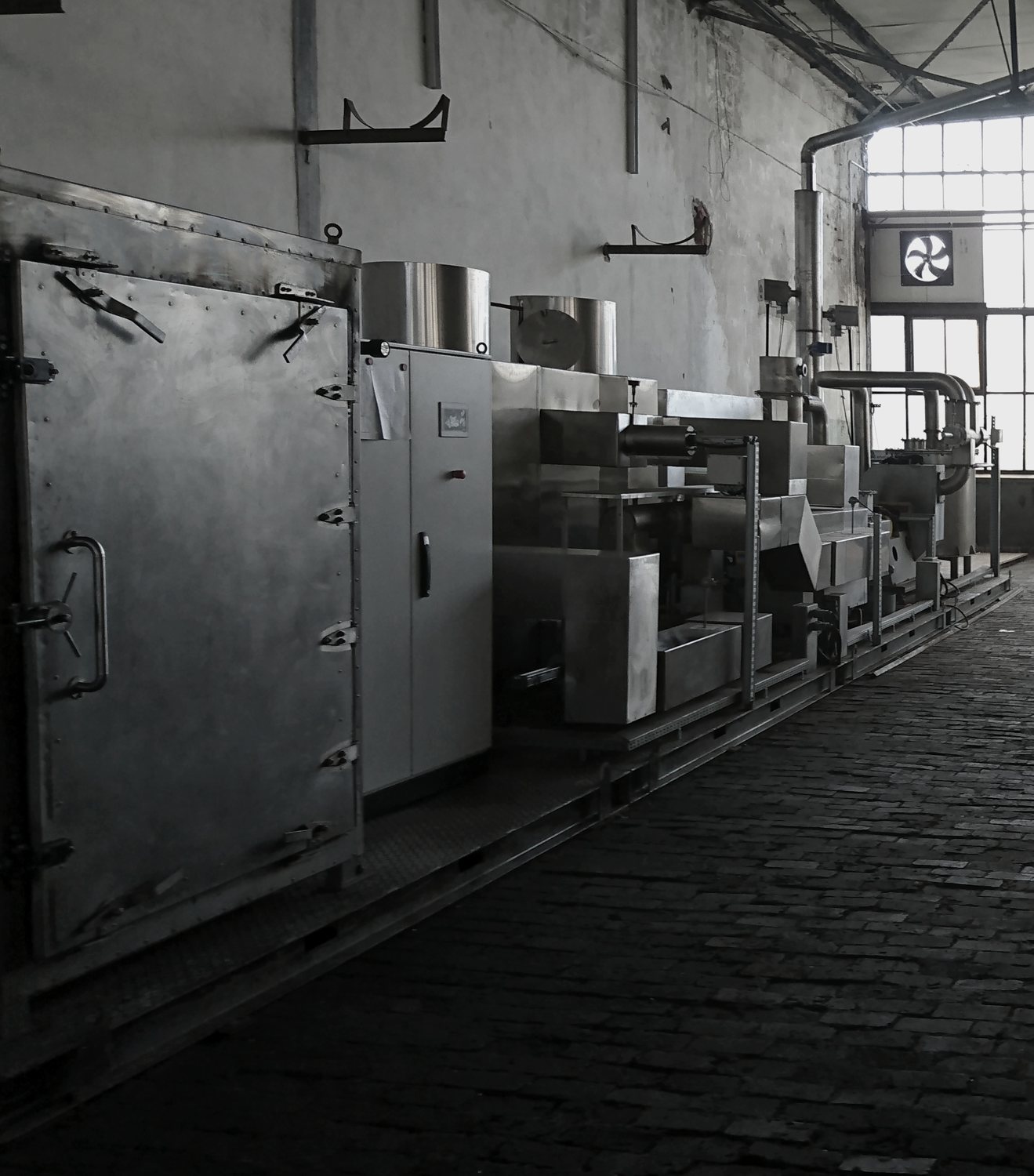
The principle is as follows. Continuous rotation of the chamber about the axis of the cylinder mixes the feed and causes fragments to abrade against one another. Abrasion removes the mineral deposit that blocks access of deeper layers of organic material to the process — a phenomenon that is one of the main causes of incomplete conversion in stationary chambers. Lifters fixed to the inner surface of the reactor raise the feed in the direction of rotation and drop it by gravity near the upper position. The fall and the impact cause the material to delaminate and, at temperatures above the melting point of tin, cause soldered components to detach from the board.
The first generation of the machine revealed significant design faults. That is the natural price of being first, and we do not conceal it: the faults were identified, documented, and form part of the documentation being transferred. For a partner building a second-generation reactor, this is information of measurable value. In parallel, in line with the original work plan, we ran a research track based on a box chamber.
Control
An allothermal process demands a different class of control from a self-sustaining one. Heat must be supplied in a manner matching the current state of the feed, whose composition varies and whose reaction course is not known in advance.
We applied a tracking control system: the algorithm leads the controlled variable after a setpoint which itself changes over time as a result of phenomena occurring outside the control loop. The executive layer consists of industrial PLCs, the supervisory and visualisation layer of a SCADA-class system. The algorithms are proprietary.
This is the most mature element of the whole body of work and the only one transferable beyond this technology. The competence of running a variable thermal process under tracking control applies to many industrial installations, not necessarily waste-related.
The product: a metal-bearing residue
The product of the process is not metal in commercial form. Gasification of printed circuit boards yields a fine mineral-and-metal residue, referred to in the literature as char — containing metals, glass fibre and ash, free of the organic fraction.
As feed material it goes to a magnetic separator, where iron is removed. The resulting concentrate is directed to downstream hydrometallurgical processing, carried out by methods long established in metallurgy. Below we use “metal-bearing residue” and “char” interchangeably; the latter is the technical term adopted in the literature.
This distinction is crucial to the business assessment. The residue requires further processing: comminution, physical separation and refining at a metallurgical plant. Value arises above all on copper and precious metals, not on aluminium.
The condition for a sound investment is not demonstrating that the reactor works, but agreeing a technical and commercial product specification with the metallurgical offtaker.
It should cover minimum copper content, settlement rules for gold, silver and palladium, permissible contents of bromine, chlorine, lead and tin, moisture, particle size, the waste status of the product, and treatment charges and deductions. Metals present in the residue and metals that are paid for are not the same thing. We regard this as the single most important practical result of the whole project and repeat it to every partner.
The greatest advantage in this model comes from selecting the feed before the process: dismantling battery components, capacitors and cables, and then directing to the reactor only those fractions for which thermal detachment of the resin genuinely raises the value of the concentrate. That is why the natural partner for this technology is a company dismantling electronic equipment — one with its own known and homogeneous stream of material.
Which metals are in play
The economics of this process are decided by copper and precious metals — gold, silver, palladium, and to a lesser extent platinum. They create the value of the residue and they are what one discusses with a metallurgical plant.
Boards and mounted components also carry elements whose significance today is political rather than merely commercial. Copper, gallium, germanium, platinum group metals and both light and heavy rare earth elements are on the EU list of seventeen strategic raw materials; tantalum, antimony, beryllium, indium and hafnium are on the wider list of thirty-four critical ones. In practice this means:
- tantalum — tantalum capacitors, common in professional and aerospace electronics;
- gallium — nitride and arsenide semiconductors, including radar transmit-receive modules;
- germanium — infrared optics, thermal imaging sensors, part of the semiconductor range;
- rare earth elements — permanent magnets in disk drives, loudspeakers and vibration motors;
- antimony — present in the laminate itself, as part of the flame-retardant system working with bromine compounds;
- indium and bismuth — displays, coatings, low-melting solders.
The presence of an element in the feed is not the same as its recovery, and recovery is not the same as commercial settlement.
Our process removes the organic fraction and leaves the metallic and mineral phases in a form allowing further treatment — it does not carry out selective separation of individual elements. Tantalum, gallium and germanium remain bound in mounted components and, in industrial practice, are obtained either by dismantling components before thermal treatment or through dedicated hydrometallurgical routes after it. We did not conduct research into recovering these elements and do not present it as a result of the project.
We name them for a different reason. The feed in question is at the same time the richest source available in Europe of several elements whose scarcity has become the subject of separate regulations and action plans. That defines the regulatory and price environment in which any entity taking up this subject will operate.
Dust and process gas: what is solved, what is open
Let us return to the conclusion set out at the beginning of this text: feasibility is decided by the gas train, and the lever is reducing its load at source. Part of that work was done in the project. The temperature regime was chosen so as not to enter the range favouring the formation of dioxins and furans, and nitrogen oxides do not form under these conditions. Dust — named in the literature among the main barriers to thermal processes for this kind of waste — was retained in our installation by a low-temperature dedusting system, and we regard that question as solved at the scale at which we worked. The literature further indicates that in allothermal steam gasification volatile contaminants, halides included, collect in the aqueous condensate; this is a promising direction, but we did not carry out the research that would let us claim to have closed it.
The final section of the gas train — removal of volatile organic compounds and of sulphur and chlorine compounds — remains an open question. The original assumptions of the project did not provide for research in this area; a solution proven commercially in other applications was to be applied. Practice showed that gas arising from the gasification of printed circuit boards, loaded with halogens, requires a research programme of its own. We did not carry one out and we do not claim the problem is solved.
Catalytic gas cleaning technologies, examined in this project as one possible direction, are today developed independently by Oxydea — in a different application, for a different kind of gas and for different industries. Oxydea is not a party to discussions concerning the NataLab assets and we do not offer its technology as part of them.
Context: the state of the art
The reference point for the project's assumptions was the work of a team at Wrocław University of Science and Technology: Agnieszka Gurgul, Włodzimierz Szczepaniak, Monika Zabłocka-Malicka, Incineration, pyrolysis and gasification of electronic waste, E3S Web of Conferences 22, 00060 (2017), DOI 10.1051/e3sconf/20172200060. It is the source of the formulation of the purpose of thermal treatment quoted above, and of the identification of allothermal steam gasification as a route allowing the organic fraction to be eliminated without a high oxygen potential in the gas phase.
The reference point for the state of the art at the close of the work was the review: S. Santos, A. C. Assis, L. Gomes, C. Nobre, P. Brito, Waste Gasification Technologies: A Brief Overview, Waste 1(1), 140–165 (2023), DOI 10.3390/waste1010011.
Comparing the two publications leads to a conclusion that says something about this market in itself: over the five years separating them, the state of the art changed little. The same questions recurred as unresolved — control of the process, dust, cleaning of the process gas. The devices described in the literature remained single-purpose research rigs with a capacity of up to a dozen or so kilograms of feed, in which it is hard to find the marks of a project prepared with commercial application in mind. Only the last few years have brought pilot-scale work — discussed below.
What the 2025 literature confirmed
The rotary reactor is the single most important achievement of this project — and, as it turns out, one that remains current. After the years of stagnation described above, two papers appeared in 2025 which independently confirm the direction we took. Both are discussed below, together with the differences that matter more, for the assessment of our assets, than the similarities.
Pilot study in a rotary kiln — Fuel, 2025
The most interesting reference point appeared four years after our reactor was commissioned. A team from Henan Polytechnic University and Wuhan University of Technology published a pilot study on the processing of printed circuit boards in a rotary kiln.
Currently, most studies have been conducted at the laboratory scale with limited pilot- or industrial-scale experiments. (…) There is a significant gap between theoretical research and practical applications.Y. Zhu, X. Wen, W. Zhang, F. Shen, Y. Cao, Pilot study on pyrolytic utilization of WPCB based on a rotary kiln, Fuel, 2025
Their design choices converge with ours on the points we considered decisive: a rotary chamber as the process vessel, a constant low rotational speed for even heating of the feed, external heating — that is, allothermal operation — and a temperature range recommended for industrial application. That is independent confirmation of the direction.
Three differences that matter more than the similarities
- The feed. The material in the 2025 study was production waste from a board factory, comminuted below 0.5 mm, from which copper and tin particles had been removed beforehand by washing. A homogeneous, clean feed stripped of metals; the study concerns valorisation of the non-metallic fraction, not metal recovery. Our reactor worked on real multilayer boards with components mounted — on the material the market actually competes for.
- The purpose of the process. That system produces oil and gas with calorific value; the maximum liquid yield was 22.4 per cent by mass. We went in the opposite direction — we gasify rather than pyrolyse precisely in order not to produce oils and tars. In a plant aimed at metals, every per cent of liquid fraction is a burden on the gas train, not a product.
- Scale. Their pilot installation ran on a 5 kg charge. Our chamber is 2.7 metres long with an internal diameter of one metre. We ran repeatable campaigns with charges in the tens of kilograms; trials at fills approaching 200 kg lost repeatability, which we attribute to the identified design fault of the first generation of the machine. The reactor was a first-attempt solution — built in order to find out what we did not yet know.
Copper recovery in a rotary furnace — RSC Advances, December 2025
The second paper concerns copper recovery from copper clad laminates in a low-temperature rotary furnace. Its authors justify the novelty of their approach in a sentence we quote without comment.
Currently, studies on the separation of metals and non-metals from WPCB or WCCL are mainly carried out in fixed-bed reactors, and there are no public reports on rotary furnaces.M. Tian, X. Zhang, High-efficiency and environmentally friendly copper recovery from waste copper clad laminate and its pyrolysis behavior through a novel low-temperature rotary furnace process, RSC Advances 15, 48498 (2025)
The sentence comes from a peer-reviewed paper accepted for publication in late November 2025. Our rotary reactor had been running since 2021.
The description of the advantages of a rotary furnace in that publication matches the solution we applied: lifters raise the material to its highest point, from which it falls along the bed, and the feed not only rotates but also translates and collides — which intensifies heat transfer and ensures thorough mixing. The authors also stress that the process does not require prior comminution of the material. That too was our premise.
Chamber fill as a first-order parameter
There is one further piece of information in that paper which we treat as a lesson about our own failure. Chamber fill proved to be a first-order parameter, and the optimum value indicated by the authors is about 52 grams per litre of reactor volume. For our chamber that would correspond to a charge in the region of 110 kg. Our repeatable campaigns fell below that value, while trials at fills close to 200 kg — roughly twice as high — lost repeatability. The convergence is striking and clarifies the picture: part of what we attributed solely to the design of the machine is probably of a more general nature and is today described in the literature.
Documentation from 2020 and 2021
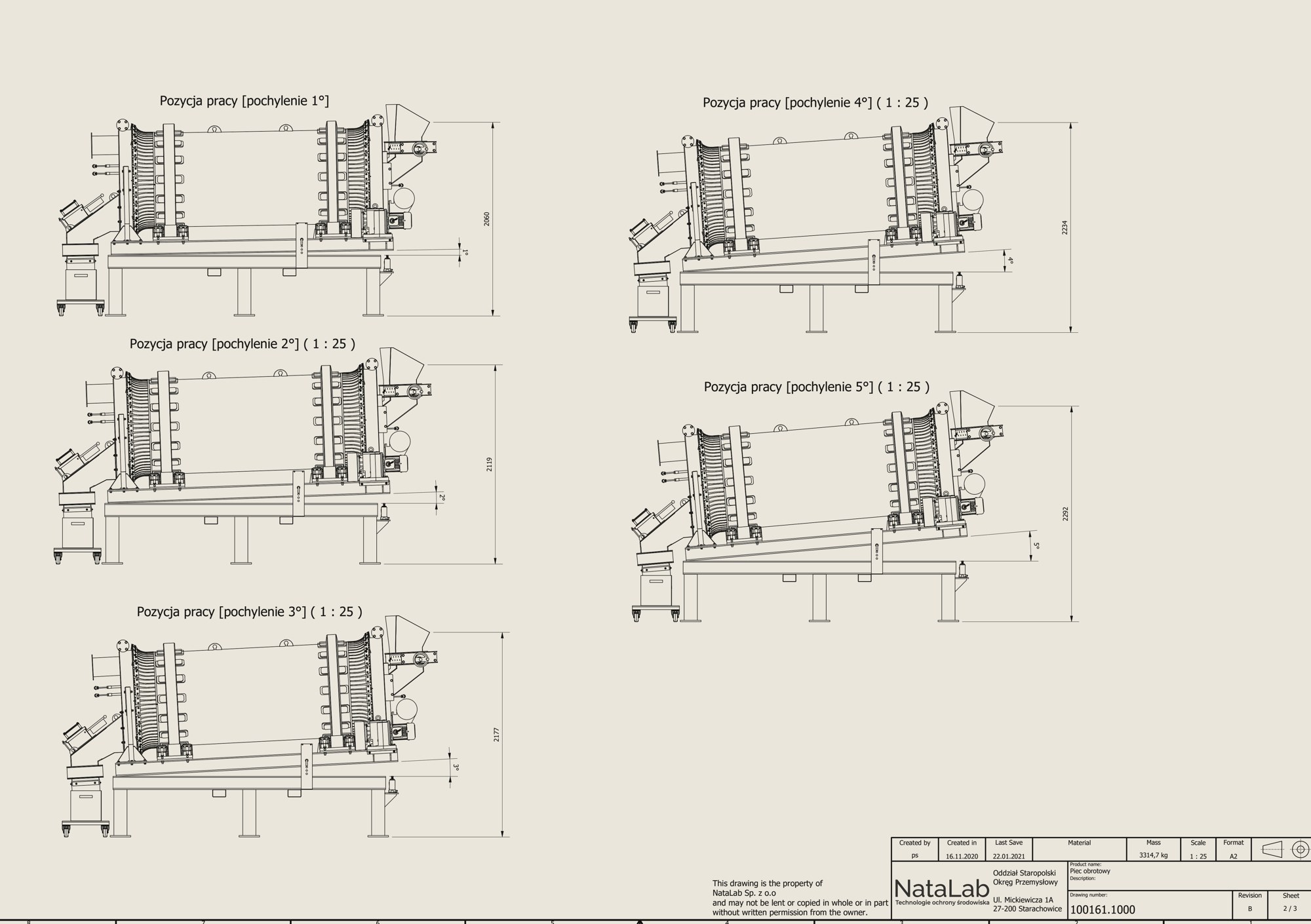
The sheet below comes from the construction documentation of the reactor and is dated November 2020 and January 2021 — four and five years, respectively, before both of the papers discussed above.
What this means for a partner
These assets are not technology ready for deployment and we do not present them as such. They are a body of solved questions, documented design faults, measurement data and competences, assembled in a project with a budget exceeding EUR 1 million — in a field where the move from a bench-top rig to pilot scale is still the subject of scientific publications.
We do not claim to remain the only ones. We claim that the direction chosen in 2017 and realised in 2021 is today being confirmed independently, that we went through this stage earlier, in a vessel an order of magnitude larger and on incomparably more difficult feed — and that we know where the traps in that stage lie. That last point is what the conversation is about.
For a company processing electronics, this is a starting point closer to the goal than starting from zero. For an entity building a research project, it is a documented component at a defined readiness level together with a ready scope of work. For an investor, it is an asset whose value depends on whether it finds an industrial owner.