NataLab
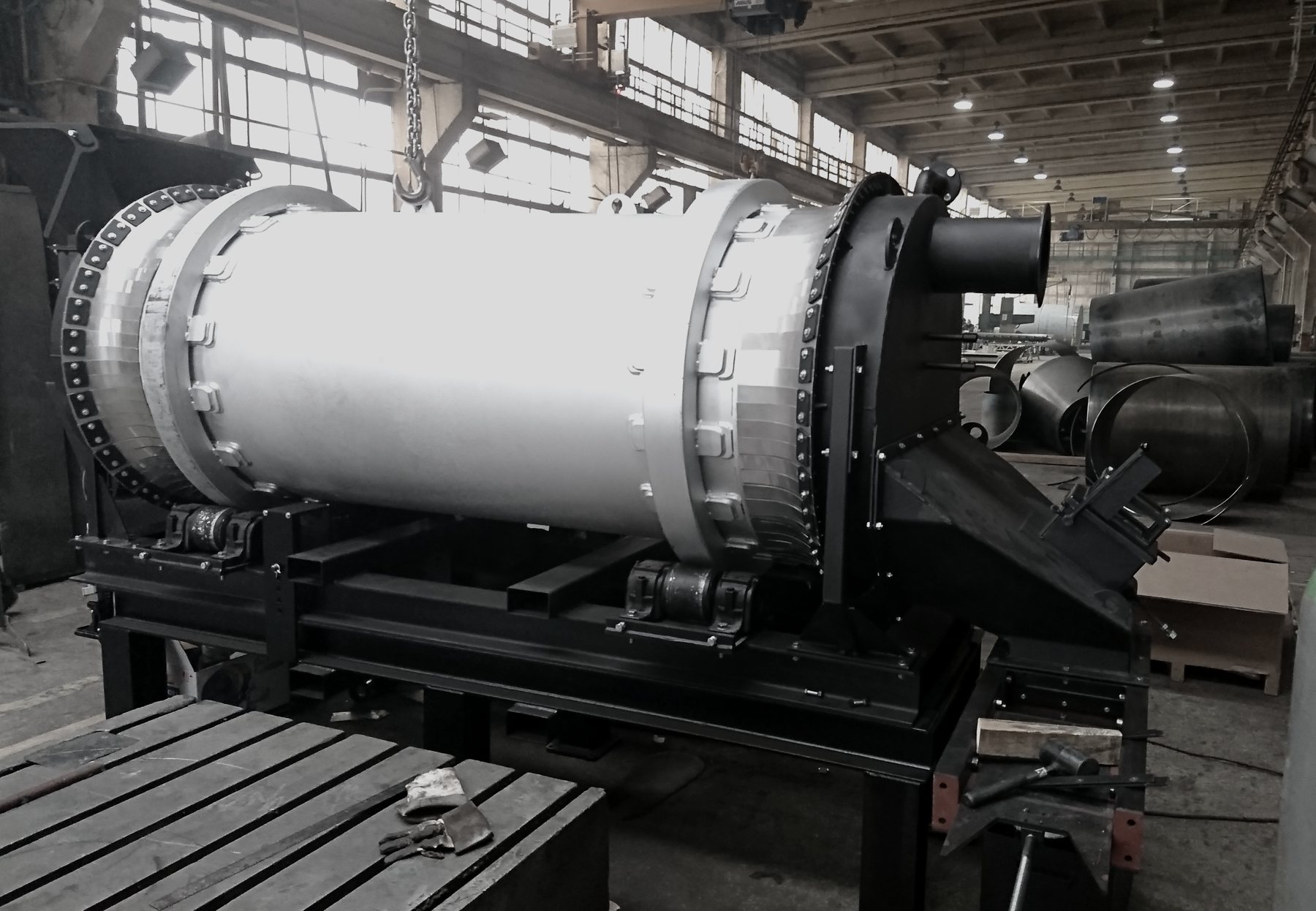
Rotary gasification reactor for printed circuit boards built in the NataLab project — view of the chamber body and flange.

Research assets for transfer

Metal recovery from printed circuit boards

We built a rotary gasification reactor for printed circuit boards with a 2.7 × 1 metre chamber — at a time when the literature described bench-top devices. We obtained a repeatable metal-bearing residue free of the organic fraction. The research budget exceeded EUR 1 million.

Where we stand

The project is closed, the assets are open to discussion

The research project has been completed. The technology was not taken through to industrial deployment.

The output of the project has not been lost. Its individual elements — process know-how, technical documentation, data from research campaigns, control software and the research apparatus — are today held by several different parties: the financial investor, former collaborators and third parties.

We know where they are. The role of NataLab is to coordinate a transaction and to take responsibility for bringing an agreed scope into a single pair of hands — through a licence, a transfer, or a contribution to a joint venture with an industrial partner. Scope, structure and the involvement of each party are agreed individually.

Below we set out what this project proved and what it did not. In that order and without rounding — because both parts matter to anyone considering taking these assets over.

01

What we proved

Repeatable process below the melting point of aluminium

We gasified printed circuit boards in a temperature regime in which aluminium and the glassy phase remain solid. The feed behaves as a fixed bed and the reactor is not flooded by a liquid phase — a condition for keeping the machine running across many cycles.

Elimination of the organic fraction

Resins, plastics and the remaining carbon-bearing components are removed from the feed. Downstream metallurgical processing therefore no longer carries the organic substances that, in conventional routes, are the source of the most problematic by-products.

A repeatable metal-bearing residue

Gasification of printed circuit boards yields a fine mineral-and-metal residue, referred to in the literature as char. As feed material it goes to a magnetic separator, where iron is removed, and the resulting concentrate is directed to downstream hydrometallurgical processing — a route based on methods long established in metallurgy.

The dust problem solved

Low-temperature dedusting of the process gas worked in our installation. In the literature, dust recurs as one of the main barriers to processes of this type.

Tracking control in an industrial architecture

The process ran under proprietary algorithms, on industrial PLCs integrated with a SCADA visualisation layer. This competence is transferable to other thermal and chemical processes.

No nitrogen oxide formation

This follows from the nature of the process: NOx formation requires temperatures far above those used in this technology.

02

What we did not prove

Process gas cleaning

We did not reach the assumed level of gas cleaning. This area was not within the scope of research in the project — the original assumption was to apply a solution proven commercially elsewhere. For gas from the gasification of printed circuit boards, loaded with halogens and sulphur compounds, this remains an open question requiring research.

Throughput

The process proved slow and the assumed chamber throughput was not achieved. Repeatability declined as the reactor fill increased — we attribute the cause to a design fault in the first generation of the machine, which has been identified and documented.

Exothermicity

We run the process allothermally, that is with heat supplied from outside. This gives greater control over its course, but is not what we assumed at the outset.

Commercial offtake of the product

We hold no confirmed offtake agreement for the residue with a metallurgical plant. In our view, agreeing a technical and commercial specification with the offtaker — minimum copper content, settlement rules for precious metals, permissible halogen levels and particle size — should precede any investment decision based on this technology. We recommend this to every partner.

We state this plainly, because each of these points would surface in the first week of due diligence anyway. We would rather the conversation started from an accurate picture.

How these assets look from the vantage point of 2026

In December 2025, in a peer-reviewed paper on copper recovery from copper clad laminates, another research team justified the novelty of its approach as follows:

Currently, studies on the separation of metals and non-metals from WPCB or WCCL are mainly carried out in fixed-bed reactors, and there are no public reports on rotary furnaces. M. Tian, X. Zhang, RSC Advances 15, 48498 (2025)

Our rotary reactor, with a 2.7 × 1 metre chamber, had been running since 2021 on real boards with components mounted. We do not claim to remain the only ones — we claim to be past a stage that, in this field, is only beginning. Full comparison with the 2025 papers →

Technology readiness

Not one number, but four

The readiness of this technology cannot be captured in a single value. Its components sit at different stages, and we consider only such a breakdown to be honest.

Gasification in the rotary reactor
TRL 4–5
Chamber 2.7 × 1 m. The first generation revealed design faults, which have been identified and documented.
Gasification in the box chamber
TRL 4
A parallel track, run alongside the rotary reactor.
Automation and process control
TRL 6–7
The most mature element, transferable to other applications.
Process gas cleaning
TRL 2–3
Unexplored area.

Levels as at the close of research work. Technology description and the limits of what was explored →

Open research questions

What remains to be investigated

This list is part of the value of these assets. For a partner planning research work it is a ready, documented and justified scope — not a hypothesis, but questions derived from specific measurement campaigns.

Context

A market that in 2017 was a hypothesis

Urban mining

A kilogram of computer motherboards contains tens of times more gold than a kilogram of gold ore. Electronics is today one of the richest available sources of copper, silver, palladium and platinum — provided one can remove from it everything that is not metal.

Critical raw materials and strategic sovereignty

The CRMA regulation set the European Union a target of covering at least 25 per cent of its demand for strategic raw materials from recycling carried out inside the Union by 2030. Poland's Chief National Geologist has publicly assessed that, with current technologies, this target is out of reach. The gap between the declaration and the capability is where demand arises.

Dual use

Electronics contains elements without which modern armament is not built: gallium — nitride semiconductors used in active electronically scanned array radars; germanium — infrared optics and night vision; rare earth elements — permanent magnets in drives and guidance systems; tantalum — capacitors operating under extreme conditions. Gallium, germanium, copper, platinum group metals and both light and heavy rare earth elements are on the narrow EU list of seventeen strategic raw materials; tantalum and antimony are on the wider list of thirty-four critical ones. The EDIP programme, adopted in December 2025 and operational from spring 2026, replaced earlier ad hoc instruments. The RESourceEU action plan of December 2025 names defence-relevant raw materials as one of three priorities, announcing EUR 3 billion within twelve months.

Metal prices and central bank demand

The gold price rose from around USD 1,250 an ounce in 2017, when the assumptions of this project were being drawn up, to over USD 4,000 in 2026. Central banks have been net buyers of gold for fifteen consecutive years: 1,092 tonnes in 2024 and 863 tonnes in 2025 — less than the year before, yet still almost twice the 2010–2021 average. This was not a one-off record but an established trend.

Reindustrialisation

Mario Draghi's 2024 report described the Union's raw material dependency and its investment gap in new technologies as a systemic threat. The documents that followed — the CRMA and then RESourceEU — shifted the emphasis from declarations to financing specific projects across the processing and recycling chain.

A stream only now returning to the system

The EU collection target in force since 2019 is 65 per cent of the average mass of equipment placed on the market over the three preceding years; Poland accounts for 45 per cent of the mass placed on the market in the current year, so the gap keeps widening. A September 2025 report by ElektroEko and the WEEE Forum estimates that over twenty years of the system some 1.5 million tonnes of waste equipment have disappeared from official collection statistics, and points to the risk of penalties from the European Commission. Tightening the system means a larger available volume for licensed processing plants. The material exists; what changes is who has access to it.

Market evidence · updated 20 September 2026

Two facts that price this market for us

We do not need to argue that processing printed circuit boards matters strategically. Over the past twelve months the Polish government and the country's largest player in this industry did it for us — one with money, the other with a decision about what is not worth looking for in Poland.

19 September 2025 · government grant

PLN 1.038 billion for an electronics metal recovery plant

The Ministry of Economic Development and Technology signed an agreement with Elemental Battery Metals for a grant of PLN 1.038 billion under the TCTF programme, for the construction of the Polvolt plant in Zawiercie. The plant is to produce copper, silver and gold and to refine battery metals. The investment was included on the European Union's list of strategic projects under the CRMA regulation — as one of two projects from Poland.

In the company's press release, its founder and chief executive Paweł Jarski gave the scale of throughput:

As the Elemental Group we process more than 40,000 tonnes of PCB and more than 110,000 tonnes of electronic waste per year. The technology and organisation of processing these materials constitute a key competence of our economy. Paweł Jarski, founder and CEO of Elemental Group — Elemental Group release, 19.09.2025 · archived copy

What this means for us. Printed circuit boards are processed in Poland at a scale of tens of thousands of tonnes a year, and the state is contributing a billion zloty to infrastructure meant to recover metals from them. Technology for preparing such a feed — that is, removing the organic fraction ahead of metallurgy — belongs to the same chain.

2 September 2026 · Council of Ministers resolution

National Critical Raw Materials Exploration Programme

The Polish Council of Ministers adopted a resolution establishing the multiannual programme “National Critical Raw Materials Exploration Programme” (KPPSK), submitted by the Ministry of Climate and Environment. It will be delivered by the Polish Geological Institute — National Research Institute, supervised by the minister responsible for the environment acting through the Chief National Geologist. Funding comes from the National Fund for Environmental Protection and Water Management, with a total cost for 2026–2033 of close to PLN 185.7 million.

This is a breakthrough moment. Today the government adopted the National Critical Raw Materials Exploration Programme prepared by the Ministry of Climate and Environment. Paulina Hennig-Kloska, Minister of Climate and Environment — via wnp.pl, 2.09.2026

The programme divides exploration into three priorities. High priority covers copper ores, platinum group metals, graphite, barite, fluorite, helium and feldspathic raw materials. Medium priority covers tungsten, titanium, vanadium, arsenic, bismuth, metallic silicon, phosphorites and strontium. Low priority was assigned to deposits of rare earth elements, gallium, germanium, lithium, hafnium, boron, antimony and scandium — because, as stated, the prospects of documenting deposits are limited in their case.

What this means for us. Those are precisely the elements present in electronics. The state says plainly that it is unlikely to find them in Polish ground. The only realistic domestic source therefore remains recovery from devices that are already here. The programme is about searching for deposits; electronics is a deposit no one needs to search for.

Set side by side, the two decisions are themselves a statement about proportion: PLN 185.7 million over eight years to search for deposits, against a single grant of PLN 1.038 billion for a plant that recovers metals from material already extracted. Let us talk about the NataLab assets →

Scope of discussion

What is on the table

The assets
Process know-how, technical documentation, data from research campaigns, control software and semi-industrial research apparatus. We do not publish an itemised list of components, nor of who currently holds them. Scope is agreed individually — a transaction may cover the whole or separated parts, according to the partner's needs.
Confidentiality
The most valuable part of these assets has never been published. Process parameters, measurement data, design solutions and control algorithms remain undisclosed. We share them once a non-disclosure agreement is in place, to an extent appropriate to the stage of discussions.
Apparatus
A significant part of the research apparatus built in the project has not been scrapped; it is held by third parties. An inspection can be arranged once contact is established and the scope of discussions agreed, though part of the apparatus is located outside Poland.
Structure
A transaction requires the participation of several parties, and part of the output is subject to security interests established in favour of creditors. Sarmatia Ventures takes part in structuring the discussions. The full legal picture is presented once a non-disclosure agreement is in place. The company's corporate affairs are in order.
Responsibility
NataLab does not act as an entity offering its own property, but as the party organising a transaction with all rightholders involved — and taking responsibility for delivering the agreed scope to the partner.
Team
Part of the former research team is available in an advisory capacity, subject to agreement on scope and terms.

Forms of cooperation

Four routes

Licence or transfer

Access to, or transfer of, documentation, data and know-how, in full or in separated parts — on terms and in a scope set for the particular transaction.

What we expect: a conversation about scope and structure, preceded by a non-disclosure agreement.

What we do not promise: technology ready for deployment — what is offered is research output at the readiness levels set out above.

Joint venture

An industrial partner brings access to feedstock, facilities and financing. The NataLab team takes a minority stake and acts in an advisory role.

What we expect: a partner with a real stream of electronic waste or with metallurgical facilities.

What we do not promise: immediate readiness — we do not currently run research work and have no active facilities. Any restart requires time and rebuilding the team.

A component in a research consortium

Assets at TRL 4–5, together with the documented scope of open questions, as a substantive contribution to a project led by another entity.

What we expect: a clearly defined role and scope of responsibility.

What we do not promise: declaring readiness levels higher than those documented.

Advisory work

Members of the former team taking part in external projects: thermal processes, automation and tracking control, construction of research apparatus, running measurement campaigns.

What we expect: a defined scope and schedule.

What we do not promise: immediate or full-time availability.

The project won the Start-up Challenge competition at the European Economic Congress in 2020 and was admitted to the InCredibles mentoring programme.

Questions and answers

Six questions that come up in the first conversation anyway

Is this technology ready for deployment?

No. Its components sit at different readiness levels: automation and process control at TRL 6–7, gasification in the rotary reactor at TRL 4–5, and process gas cleaning at TRL 2–3, an unexplored area. What is under discussion is research output, not a plant ready to start. We say so plainly, because it would surface in the first week of due diligence anyway.

What exactly can be the subject of a transaction?

Process know-how, technical documentation, data from research campaigns, control software and the research apparatus. These elements are today held by several different parties — the financial investor, former collaborators and third parties. NataLab coordinates the transaction and takes responsibility for delivering the agreed scope to the partner. We publish neither a list of components nor who holds which; that is presented once a non-disclosure agreement is in place.

Does the research apparatus still exist?

Yes. A significant part of the research apparatus is held by third parties. An inspection can be arranged once contact is established and the scope of discussions agreed, though part of the apparatus is located outside Poland. The hall in which the installation operated was vacated and returned to its owner long ago.

Why is electronics recycling discussed in dual-use terms?

Because printed circuit boards and mounted components contain elements without which modern armament is not built: gallium — nitride semiconductors in active electronically scanned array radars; germanium — infrared optics and night vision; rare earth elements — permanent magnets in guidance systems and drives; tantalum — capacitors operating under extreme conditions; antimony — a component of flame-retardant systems and alloys.

The significance of that set has ceased to be theoretical. The CRMA regulation placed gallium, germanium, copper, platinum group metals and rare earths on the EU list of seventeen strategic raw materials, and tantalum and antimony on the wider list of thirty-four critical ones. The RESourceEU action plan of December 2025 named defence-relevant raw materials as one of three priorities. Meanwhile Poland's National Critical Raw Materials Exploration Programme, adopted on 2 September 2026, assigned low priority to exploration for deposits of rare earths, gallium, germanium, antimony and hafnium, citing limited prospects of documenting them in Polish ground. If those elements cannot be mined domestically, the only realistic domestic source remains recovery from devices already in the country.

Does NataLab carry out research work today?

No. The company has no operations, employs no research team and has no active facilities. Resuming work is possible only with a partner contributing feedstock, facilities and financing — and would require time and rebuilding the team. We do not plan to restart the project on our own and make no promises in that regard.

Who does an enquirer actually talk to?

Discussions are conducted by Sarmatia Ventures — the company's venture builder and financial investor, taking part in structuring the transaction. At this stage we do not put forward the names of former team members; their involvement is agreed individually, along with the scope of any advisory cooperation.

Contact

Get in touch

Discussions concerning the NataLab assets are conducted by Sarmatia Ventures, the company's venture builder and financial investor.

We reply to every enquiry — from companies in electronics processing and metallurgy, through advisers preparing research projects, to technology brokers and investors.

We normally reply within a few working days. If you prefer to write directly: biuro@sarmatia.vc